A fluent final answer is not enough evidence.
In an agentic workflow, the answer is the last artifact. The more useful evidence is the path: what the system read, which tools it called, what it skipped, what it retried, where a human stepped in, and what the run cost.
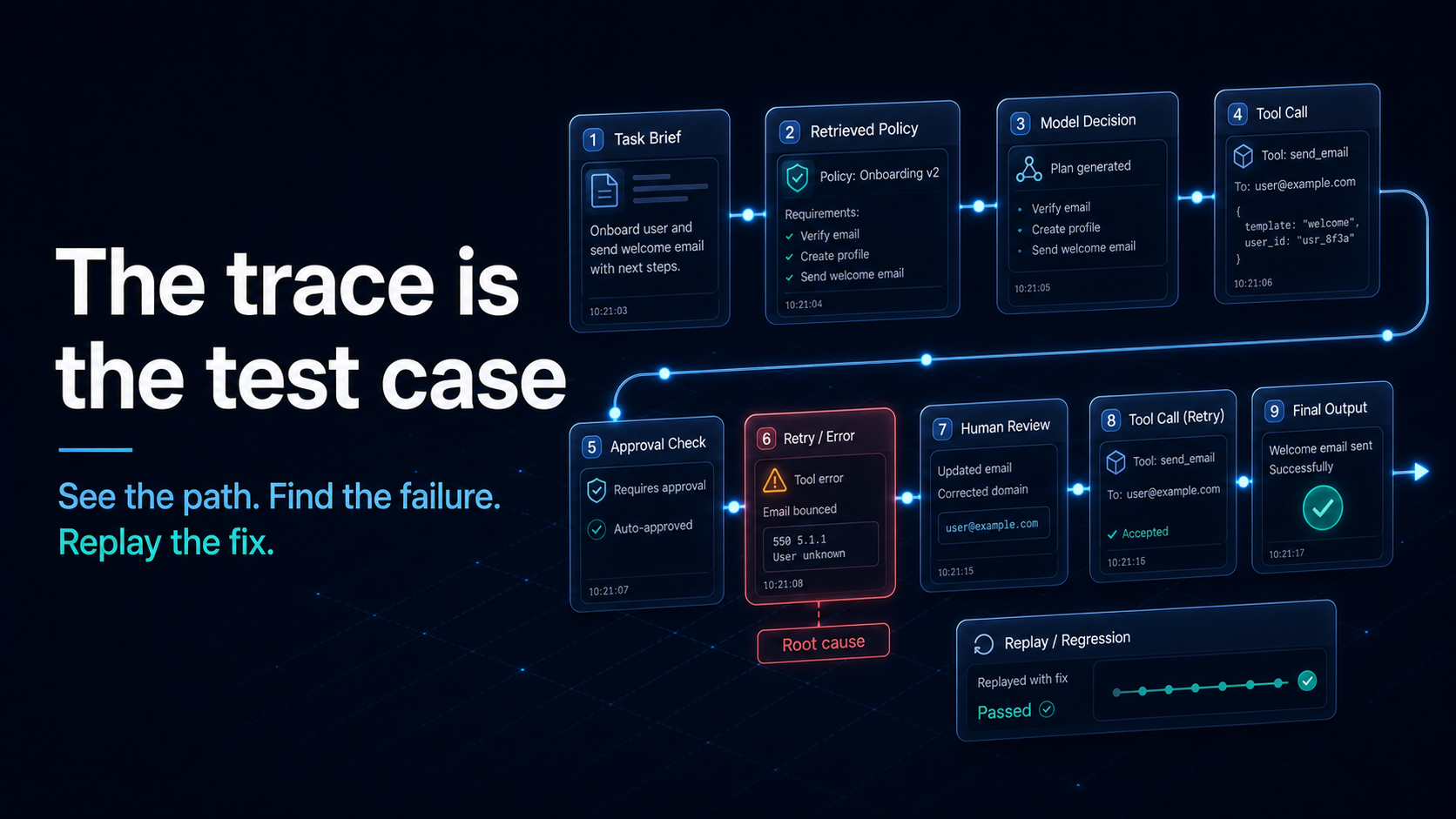
That path is the trace. For production agents, the trace is often where the best test cases start.
This is a shift from how many teams talk about AI quality. The conversation often starts with model benchmarks or answer grading. Those are useful, but they do not tell the whole story when the system is allowed to retrieve context, call tools, ask for approval, hand off work, and try again after failure.
A final answer can look good while the workflow behaved badly.
The final answer is too small
Imagine a procurement agent that recommends a vendor.
The recommendation might be well written. It might even be acceptable. But the final paragraph does not tell you whether the agent used the current policy, retrieved the right contract, respected the approval threshold, compared the right vendor record, or skipped a required risk check.
If the recommendation is wrong, the final answer is only the symptom.
The trace shows where the failure began. Maybe the retrieval step pulled stale policy context. Maybe the agent called the wrong supplier tool. Maybe it ignored a tool error and continued. Maybe the workflow never asked for human approval because the threshold lived in a document the agent did not see.
Those are different failures. They need different fixes.
One fix might be better retrieval. Another might be a stricter tool contract. Another might be a new approval gate. Another might be a regression eval built from the failed run. You cannot choose the fix if all you inspect is the final answer.
What a useful trace captures
A useful trace is not a decorative log. It is the execution record the team uses to debug, evaluate, and govern the workflow.
A trace is a record, not a dashboard
The application creates the trace as the work runs. It ties the task and acceptance criteria to the context retrieved, model calls made, tools used, approvals requested, retries attempted, and result returned. A dashboard can help display that record, but the dashboard is not the trace.
The trace does not need to start as an elaborate observability program. It needs to let someone other than the agent answer a basic question: what did the system do, why did it do it, and where did the run first go wrong?
For an agentic system, I would want the trace to capture:
- The task and acceptance criteria.
- The retrieved sources and their freshness.
- The model calls and tool calls.
- Tool inputs, outputs, errors, and retries.
- Approval requests and human interventions.
- Handoffs, escalations, and blocked states.
- Cost and latency.
- The final output and reviewer disposition.
That gives the team something to score beyond the answer.
Tool-call names alone are not enough. The team needs the inputs and results that explain the call, the error and retry behavior when it fails, the identity and permission context when the action matters, and the approval or human handoff when the system crosses a boundary. That is how a trace becomes evidence instead of a stream of events.
Did the agent use the right source? Did it call the right tool? Did it stay inside permissions? Did it create unnecessary review work? Did it finish cheaply enough and fast enough for the workflow? Did a human have to repair the same failure pattern again?
The trace also helps separate quality problems that otherwise get blended together. A bad output might come from a weak model, stale context, a missing tool result, an unclear approval rule, or an impossible task. Those failures can look identical in the final answer. They look different in the trace.
This matters for human review as well. A reviewer who only sees the final answer has to guess how much work to redo. A reviewer who sees the trace can focus attention on the weak step. If retrieval was clean and the tool call failed, inspect the tool. If the tool was right and the approval rule was missing, fix the workflow. If the model ignored a source, add an eval case.
This is where evals become practical.
A useful eval set includes synthetic prompts, golden tasks, known production failures, edge cases, and representative workflows. When the agent fails in production, that failure should become a replayable case. The team should be able to ask whether a new model, prompt, tool contract, or context rule fixes the behavior without breaking something else.
The loop can be small. A failed vendor recommendation shows a stale policy retrieval. The team tags it as a stale-policy failure, adds the run to the regression set, changes the freshness rule, and replays the case. The test case begins in the trace.
So does the ownership of the fix.
That is ordinary regression thinking applied to agent behavior.
What leaders should ask
Leaders do not need to choose the eval tool themselves. They do need to know whether the team can see the work.
If the answer is “we check the final output,” the system is probably under-instrumented.
A better operating review sounds different:
- Show me three failed runs from last week.
- Show me where each failure began in the trace.
- Show me whether the failure was context, tool, permission, model, or workflow design.
- Show me which failures became regression cases.
- Show me whether cost or latency changed after the fix.
The leadership review should include real failed runs, where each failure began in the trace, who owns the fix, and whether the case entered regression.
That conversation changes the quality bar.
It also changes incentives. Teams stop rewarding the most polished answer and start rewarding the most inspectable run. That is a healthier bar for agentic work because it values debuggability, recovery, and learning.
The point is not that every team needs the same eval platform. The point is that agent quality needs an execution record, not just an answer grade.
That execution record is how the team learns from failure without relying on memory, anecdotes, or confidence in a clean demo.
Before you expand agent autonomy, ask whether the team can show ten real agent failures and explain exactly where in the trace each one began. Here are a few practical ways to start.
A few things to try
- Trace one real workflow end to end. Start with an agent task the team already understands. Capture the task, sources, model calls, tool results, approval decisions, retries, cost, latency, and final disposition. The first useful trace is usually less about completeness than making one run reviewable.
- Review the trace beside the final answer. Ask a reviewer to identify the first weak step, not just whether the final response looks plausible. That question separates a model error from stale context, a tool failure, a missing approval, or an unclear task.
- Add a trace reference to the handoff. When an agent escalates work or a reviewer takes over, the person receiving it should have the trace or a compact execution summary, not a chat transcript and a final answer with no evidence behind it.
- Turn one failure into a replayable case. Pick a recent miss, label the failure mode, define what should have happened, and rerun it after a prompt, model, source, tool, or policy change. Include the expected cost and latency where they matter to the workflow.
- Give the trace an owner. Decide who can inspect it, how long it is retained, who fixes instrumentation gaps, and which failures enter regression. If no one owns that path, the team is still relying on memory when the agent gets something wrong.
Can your team show ten real agent failures and explain exactly where in the trace each one began?