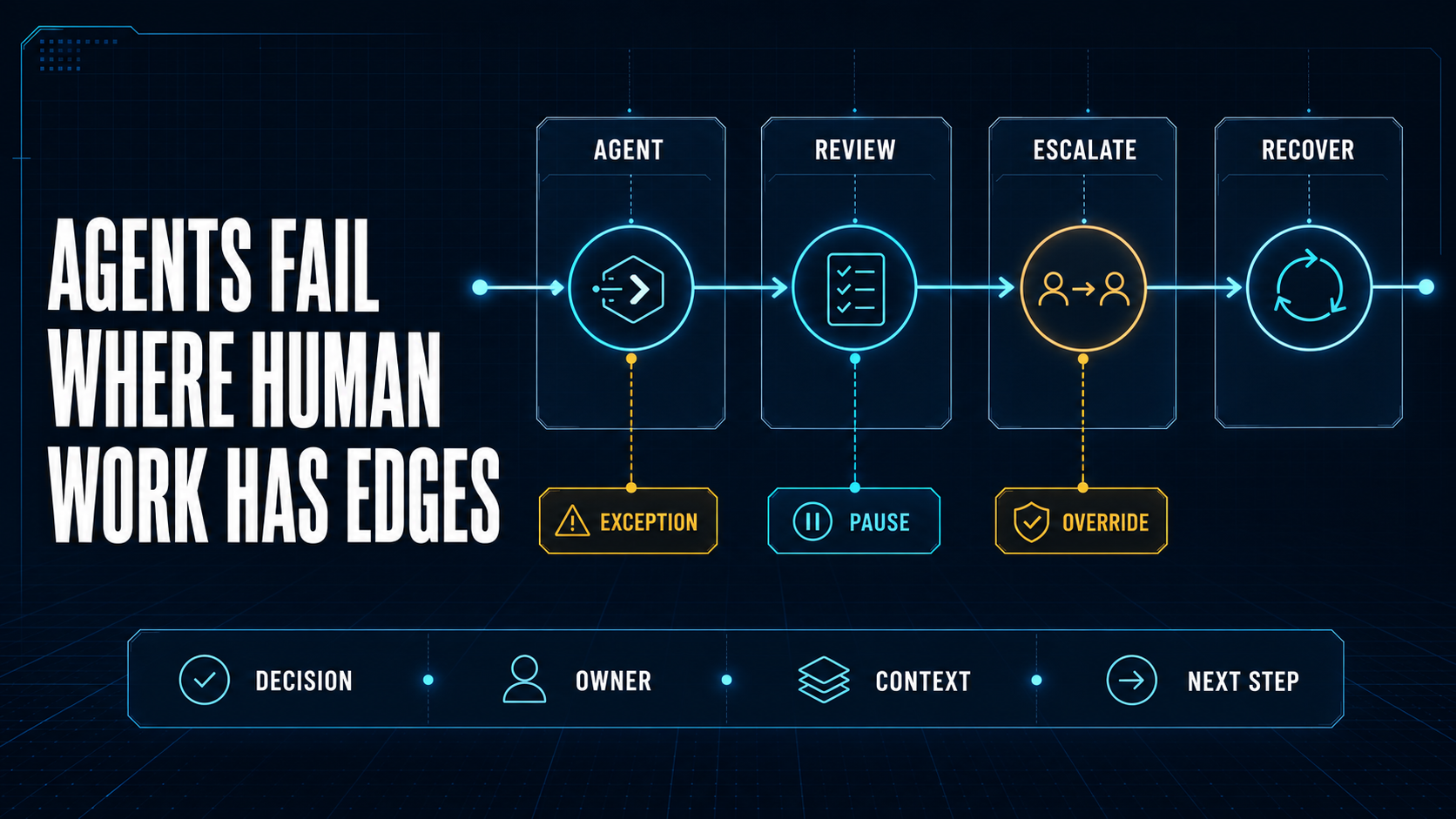
The first week of real use often teaches more than the demo.
In a demo, the agent gets a clean task, a patient operator, and a narrow success path. In production, the work has edges. Someone is uncertain. A policy conflicts with a customer request. A reviewer is overloaded. A handoff is unclear. A recommendation is technically correct but politically unusable. A failure needs recovery, not another answer.
That is where many agents struggle.
Human workflow fit is not a soft adoption topic. It is where responsibility, interruption, review, escalation, and recovery actually happen.
If the agent does not fit those edges, the team will route around it.
Consider a claims-processing agent.
It can prepare a recommendation, summarize the evidence, and draft the customer response. That sounds useful. But the workflow breaks if nobody knows when to interrupt it, what confidence threshold requires review, who owns exceptions, how rejected recommendations are recorded, or how the system learns from a human override.
That routing-around is easy to miss. A team can use the agent every day and still send the real decisions through Slack, email, or a spreadsheet.
Logins, message counts, and accepted suggestions can be useful, but they do not prove the workflow changed. Leaders should also ask which decisions moved, which handoffs improved, and which exceptions still bypass the system.
For an AI enablement leader, the adoption question is not “are people using the tool?” It is “which decisions moved into the new workflow, which exceptions still bypass it, and what evidence shows the business is better off?”
Work has boundaries
Most enterprise workflows are not straight lines.
They have decision points. Review thresholds. Exceptions. Escalation paths. Interruptions. Ownership boundaries. Confidence levels. Compliance constraints. Customer commitments. Existing contracts. People who know when the official process and the real process differ.
An agent that ignores those boundaries may still produce polished work. It may also land in the wrong part of the workflow.
The claims example is not a training problem alone. It is operating design.
Human review is part of the system
For many high-value workflows, human review is not temporary weakness. It is part of the control model.
The question is how that review is designed.
Bad review feels like babysitting. The human watches every step because nobody trusts the system.
Better review is targeted. The agent handles bounded work, shows its evidence, asks for approval at defined thresholds, and escalates when the task leaves its lane. The human sees the decision, the sources, the trace, and the proposed next action.
That reduces review debt.
It also improves trust calibration. Users learn when the agent is reliable, when it is uncertain, and when it should stop. The system learns from acceptance, rejection, edits, and escalation.
That learning has to be captured somewhere. If human corrections disappear into chat history or memory, the workflow does not improve. Rejections should update examples, evals, context rules, tool contracts, or approval thresholds.
Acceptance rate can help, but only if it is interpreted carefully. A high acceptance rate may mean the agent is useful. It may also mean the task is too easy or reviewers are not checking closely. Rejection reasons are often more useful than the percentage itself.
Design for the edge cases
The practical design exercise is to map the edges of the work.
For one workflow, ask:
- Where do humans make decisions today?
- Which decisions are reversible?
- Which decisions are externally visible?
- Which exceptions require escalation?
- What confidence threshold triggers review?
- What does the agent do when it is blocked?
- Who owns recovery?
- How are human overrides recorded?
- Which acceptance and rejection patterns feed back into the system?
This is workflow architecture and ownership design. If the agent hands work to a person, that person needs authority, context, and time to act. If the agent escalates to a queue nobody owns, the workflow has not become more autonomous. It has created a new waiting room.
The same applies to interruptions. A human should be able to pause, redirect, or reject the agent without breaking the workflow. If intervention requires starting over, people will either avoid the agent or accept bad work to keep moving.
Not every adoption problem has the same cause. Some are incentives. Some are UX. Some are data quality. Some are governance. Some are simply bad use-case selection.
Agents have a better chance of sticking when they fit the decision, review, interrupt, recovery, and trust points in the existing workflow.
That means leaders should inspect the work before buying the automation story.
The inspection should include the moments where the current process is informal. Who knows the exception? Who can approve the workaround? Who notices when the system is technically correct but commercially unwise? Those edges are often where trust is built or lost.
A good agent design makes those moments visible. It does not pretend they are defects in human behavior. It treats them as part of the work.
If the workflow has no clear owner, the agent will not fix that. If exceptions are handled through informal backchannels, the agent will expose that. If review thresholds are political, the agent will inherit that ambiguity. If nobody knows how failure recovers, the agent will make the gap more visible.
Autonomy does not remove ownership. It exposes where ownership was already unclear.
The final question for the series is when the agent is uncertain, wrong, or blocked, who notices, who decides, and how does the work recover? Here are five ways to test whether the workflow has an answer.
A few things to try
- Map one workflow’s edges. Mark decisions, exceptions, handoffs, interruptions, approvals, and recovery points from intake through completion. Include the informal paths people use when the official process does not fit.
- Set one review threshold. Choose a decision with real consequences and define the evidence, confidence, cost, or risk condition that requires human review. Name the reviewer’s authority and the response time the workflow assumes.
- Test interruption and recovery. Pause the agent during a live-like run, redirect it, reject its recommendation, and resume the work. Record whether the person can intervene without losing context or restarting the task.
- Capture one override as evidence. For a rejected or heavily edited result, record the reason and decide whether it should update an example, eval, context rule, tool contract, or approval threshold. Do not leave the correction only in chat history.
- Assign ownership for the waiting room. Inspect every escalation queue and handoff. Name who monitors it, who can decide, what information arrives with the task, and how unresolved work becomes visible before it stalls.
When the agent is uncertain, wrong, or blocked, who notices, who decides, and how does the work recover?